

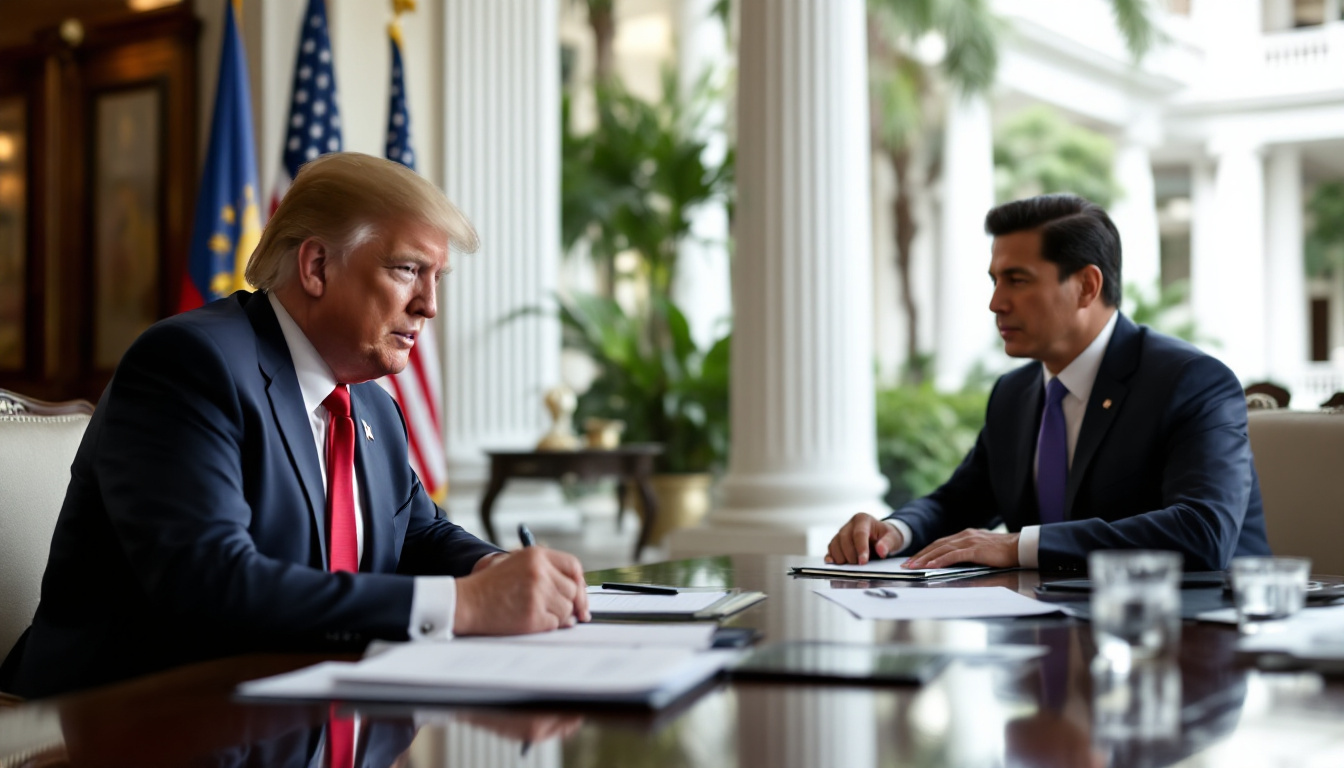
President Trump walked into a state luncheon at Malacañang Palace in Manila on Wednesday and told Philippine President Ferdinand Marcos Jr. that the two countries had just "consummated a very big trade deal, the biggest trade deal we've ever made by far." The deal, he said, "took place very quickly."
That was the second bilateral trade agreement in two days. He hasn't even landed in China yet.
The Philippines announcement came hours after Trump and Thai Prime Minister Anutin Charnvirakul signed a joint statement on the sidelines of the ASEAN Summit committing Thailand to eliminate all tariffs on U.S. goods and purchase an estimated $2.6 billion in additional American agricultural products. Thailand also agreed to remove non-tariff barriers on American vehicles, medical devices, pharmaceuticals, ethanol, and poultry. Trump called it "a wonderful deal for both parties."
The Philippines deal is broader in scope. Trump posted on Truth Social that he was "pleased to announce that we made a new and completely different trade deal with the Philippines, one that will be a true landmark, and, in particular, a deal that will be great for our farmers and those in the business of 'energy.'" During the bilateral meeting at Malacañang, Trump told Marcos they were "going to probably do something very big" on nuclear energy cooperation between the two countries.
"It's a magnificent deal for both," Trump said at the luncheon. "And it's a fair deal for both countries."
Marcos responded by describing the partnership as "building stronger ties in trade, in investment, in energy, in technology, resilient supply chains, education." Trump, on Truth Social, called Marcos "a powerful leader, and a man of high integrity and substance."
Philippine Ambassador to the United States Jose Manuel Romualdez said the U.S. "offered for us to diversify our food supply and energy requirements." The NY Post reported that Philippine officials characterized the agreement as an understanding on economic cooperation, with trade representatives set to translate commitments into concrete initiatives. The formal details will follow the same path as the Thailand deal — framework first, finalization in the coming weeks.
So here's the three-day Asia trip scorecard as it stands. Day one: joint trade statement with Thailand worth $2.6 billion in new agricultural purchases alone, plus the elimination of every tariff Bangkok charges on American exports. Day two: a trade framework with the Philippines covering agriculture, energy, and nuclear cooperation that Trump called the biggest deal of the trip so far.
Day three is Shenzhen, where Trump meets Chinese President Xi Jinping for the APEC summit and sits down for trilateral nuclear talks with Xi and Russian President Vladimir Putin. Trump has also floated a possible meeting with North Korean leader Kim Jong Un.
Back home, the same people who spent two years insisting the tariff strategy would collapse the global economy are watching Trump stack bilateral wins across Southeast Asia like he's running a clearance sale. Thailand dropped every tariff. The Philippines signed on to a landmark energy and agriculture framework. And the biggest meeting of the trip — the one with Xi — is still ahead.
The $2.6 billion in Thai agricultural purchases alone would have been a headline on any other president's Asia trip. For this one, it was the warm-up act.

Comments are closed.