

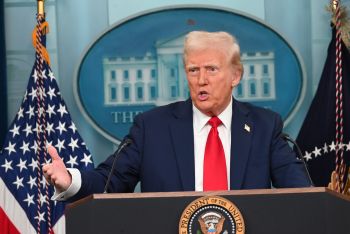
President Trump took a flamethrower to media reports claiming the United States is cutting a $300 billion check to Iran, calling the narrative pure fabrication — and the actual terms of his Memorandum of Understanding bear him out. The press ran with the scariest possible headline before reading the document.
Trump's response on Truth Social was direct: "There is no 300 Billion Dollar payment to Iran by the U.S. That's Fake News! All there is for the U.S. is Success, Lower Oil Prices, and Victory."
He's right. And the agreement itself says so.
The MOU states that "The United States of America undertakes with regional partners to develop a definitive, mutually agreed plan with at least USD 300 billion for the reconstruction and economic development of the Islamic Republic of Iran." The operative phrase is "with regional partners." That is not a Treasury Department wire transfer. That is a multilateral economic framework — and the distinction matters enormously.
Those regional partners are the Gulf states: Saudi Arabia, the UAE, Qatar, Kuwait, and their neighbors. These are some of the wealthiest sovereign wealth funds on earth, sitting on oil revenues that dwarf most national budgets. They also share a region with Iran and have a direct strategic interest in what a stable, post-sanctions Iranian economy looks like. Not one dollar of American taxpayer money is committed to Iran's reconstruction. The $300 billion doesn't come from Washington. It comes from Gulf capitals that have the capital, the motive, and — under this framework — the obligation to provide it. Trump didn't send money to Tehran. He structured a deal in which Iran's own neighbors become the financial guarantors of Iranian nuclear compliance. That is a fundamentally different transaction than what was reported.
Here's what's actually in the agreement, according to Fox News. The U.S. Treasury will issue waivers for the export of Iranian crude oil, petroleum products, and all associated services. In exchange, Iran guarantees toll-free transit through the Strait of Hormuz for a 60-day negotiation period and commits to down-blending its enriched uranium stockpile under IAEA supervision. That stockpile is 900 pounds of uranium enriched to 60 percent — close enough to weapons-grade that its disposition is a central concern of every serious nonproliferation framework in existence. Getting Iran to reduce it under international monitoring, without a military strike, is a concrete and verifiable concession.
Senior U.S. officials told Fox News they entered the talks with "the full expectation that they will lie and they will cheat." That is not the language of an administration that believes it is dealing with trustworthy partners. It is the language of an administration that has built the enforcement architecture to assume bad faith — contingent sanctions relief, IAEA monitoring, and a 60-day window before anything becomes permanent.
That word "contingent" is doing considerable work in this agreement, and it is exactly the word that was missing from Obama's JCPOA. Under that deal, sanctions relief was front-loaded and structural compliance was treated as a formality. Iran pocketed the economic benefits and the international community spent years arguing about whether they were technically complying with the letter of an agreement they had clearly abandoned in spirit. Here, the economic benefits Iran wants remain conditional on behavior the world can verify.
The deal also stipulates no new U.S. sanctions or troop deployments during the 60-day negotiation window, with U.S. forces eventually returning to pre-Operation Epic Fury posture levels within 30 days of a final agreement. UN, primary, and secondary sanctions get terminated — but only after Iran delivers.
Officials acknowledged the agreement has gaps. "Of course that's a flaw, and we will push for more than that," one senior official said. "But the fact that they're conceding to that is a major, major win." Earlier rounds of negotiation, they revealed, stalled because Iran was "just dragging us along and kind of bulls*ting us." The administration's response was to stop accommodating Tehran's stalling. "We were trying to accommodate their domestic messaging and their domestic politics," one official said. They stopped doing that.
Iranian Parliamentary Speaker Mohammad Bagher Ghalibaf is selling the deal domestically as a win for Tehran. The economics don't support the argument. Iran's economy is in freefall, its uranium leverage is about to get supervised into compliance, and the terms it agreed to make Obama's JCPOA look like a starting point rather than a finish line.
The $300 billion number was real. The story attached to it wasn't. Trump didn't send money to Iran — he structured a deal in which Gulf states fund Iranian reconstruction as the price of Iranian nuclear compliance, extracted verifiable concessions on weapons-grade material, and built enforcement mechanisms that require Iran to deliver before it receives anything. That's the document. Read it.

Comments are closed.