

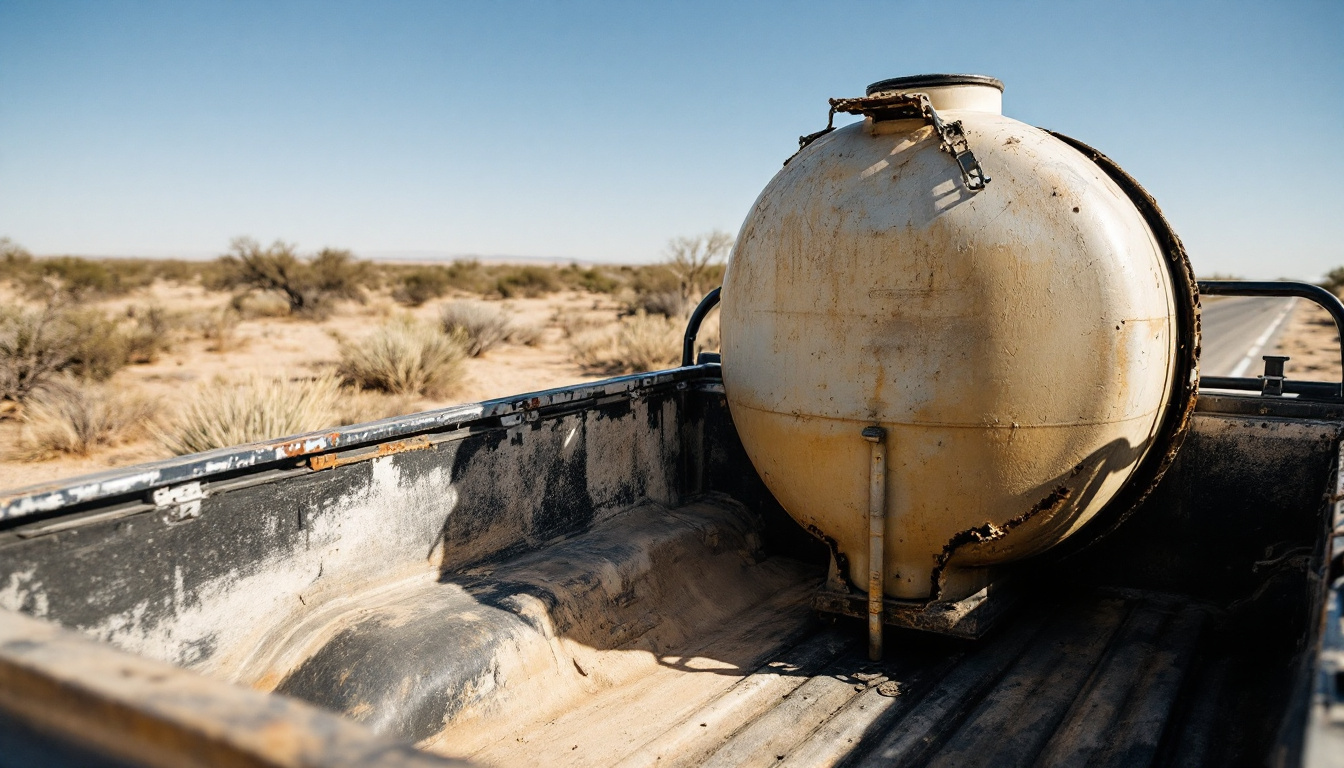
On the evening of September 14, Border Patrol agents in Eagle Pass, Texas pulled over a pickup truck and found four human beings sealed inside a portable water tank bolted to the truck bed. The agents needed power tools to cut them out. Two were from Bolivia, one from Cuba, one from Colombia.
The driver was a 19-year-old American citizen.
This wasn't a desperate migrant driving his family across the desert. This was an American teenager running a smuggling operation — sealing people into a metal box with no ventilation and no way out, then driving through south Texas like he was hauling landscaping equipment. He's been transferred to Homeland Security Investigations and faces alien smuggling charges, according to Americans Digest.
Anthony Good, the Border Patrol's Del Rio Sector Chief Patrol Officer, put it plainly: "Smugglers don't care for the safety of those they see as mere human cargo. Putting people in confined spaces with no means of escape is dangerous and barbaric. If not for the actions of our highly trained agents, this incident could have resulted in tragedy."
All four migrants declined medical treatment and were processed into Border Patrol custody. They were lucky. A water tank in the bed of a pickup in September in south Texas is an oven with a lid welded shut. The only reason this story has survivors is because agents caught the truck before the heat didn't.
The Eagle Pass incident wasn't isolated. Near Ocotillo, California, another 31 migrants were discovered in a separate smuggling operation. Thirty-one. That's not a trickle. That's a logistics chain, and it's adapting in real time to tighter border enforcement.
And that's the part the open-borders crowd will never say out loud. Stricter enforcement works — the crossings are harder, the routes are longer, the chances of getting caught are higher. But the cartels don't respond to tighter enforcement by closing up shop. They respond by getting more creative and more brutal. Water tanks. Tractor trailers. Drainage tunnels. Every new method is more dangerous than the last, and every dead migrant is a direct consequence of the business model the cartels built on top of decades of American policy failure.
The people who spent years calling border walls "immoral" never had an answer for what happens when you leave the door open and let criminal enterprises control the traffic. The cartels filled the vacuum. They're not humanitarian organizations. They're logistics companies that move human freight, and they calculate acceptable losses the same way FedEx calculates damaged packages.
The Del Rio Sector has been one of the busiest corridors on the southern border. Agents there were among those reassigned to Laredo back in April during a surge. The manpower shell game at the border means the same agents rotating between crises are also the ones cutting people out of metal containers with power saws.
A 19-year-old with a pickup truck and a welding kit. Four people locked in a box they couldn't open from the inside. September heat in Eagle Pass.
The only thing between those four migrants and a death count was a traffic stop.

Comments are closed.