

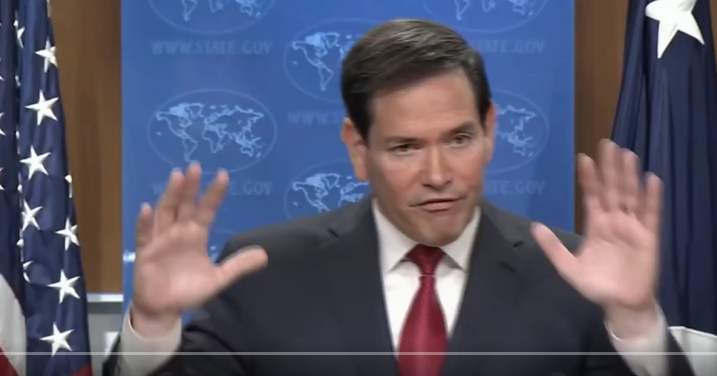
Secretary of State Marco Rubio didn't just announce sanctions against the International Criminal Court this week. He announced a financial blockade — banning all transactions between U.S. entities and the ICC, cutting the court off from American companies and the U.S. financial system entirely.
Previous administrations sanctioned individual ICC judges and prosecutors. Rubio sanctioned the institution.
The escalation came after the ICC issued an arrest warrant for Israeli Prime Minister Benjamin Netanyahu, charging him with "war crimes and crimes against humanity" during the Gaza offensive — including the "use of starvation as a weapon and directing attacks against civilians." The warrant wasn't just aimed at Netanyahu. The ICC has signaled interest in prosecuting American officials, too, which is the part that turned a diplomatic disagreement into something closer to a declaration.
Rubio, speaking from the State Department, laid out the administration's position in terms that left exactly zero room for interpretation. "The United States and the American people are not subject to the jurisdiction of this fake ICC," he said. Not "disputed." Not "controversial." Fake.
He went further. "For decades now, both Republicans and Democrats have rejected the idea that the International Criminal Court has any power to prosecute American citizens," Rubio said, framing the move not as a partisan escalation but as a bipartisan consensus the ICC chose to ignore.
Then he named targets. "They want to prosecute Border Patrol agents that are protecting our nation's borders, and they want to prosecute our elected leaders," Rubio said. "They want more power, and they want it at the expense of our sovereignty as a nation."
That's the core of it. The ICC wasn't content going after foreign heads of state in countries without the leverage to fight back. It started reaching for the officials of nations that never signed onto its jurisdiction in the first place — and expected those nations to comply anyway.
The financial dimension is where Rubio's move has real teeth. "We will ban transactions with this rogue court, cutting off their resources and crippling their ability to operate against us," he said. The ICC runs on funding, cooperation agreements, and access to international banking infrastructure. Losing the American financial system doesn't just inconvenience the court. It isolates it.
Rubio also had a message for allied nations that have cooperated with ICC warrants or signaled willingness to enforce them. "We expect our allies ... to rein in this rogue court," he said. The implication — that U.S. defense cooperation and diplomatic goodwill are not unconditional — wasn't subtle. It wasn't supposed to be.
The ICC responded by condemning the sanctions and vowing to continue operations, which is roughly what you'd expect from an organization that just lost access to the world's largest financial system and responded with a press release.
"We don't need that court, and we don't want it," Rubio said.
He closed with eight words that will either age as a prediction or a promise. "Either the ICC will end its threats, or we will end the ICC."

Comments are closed.