

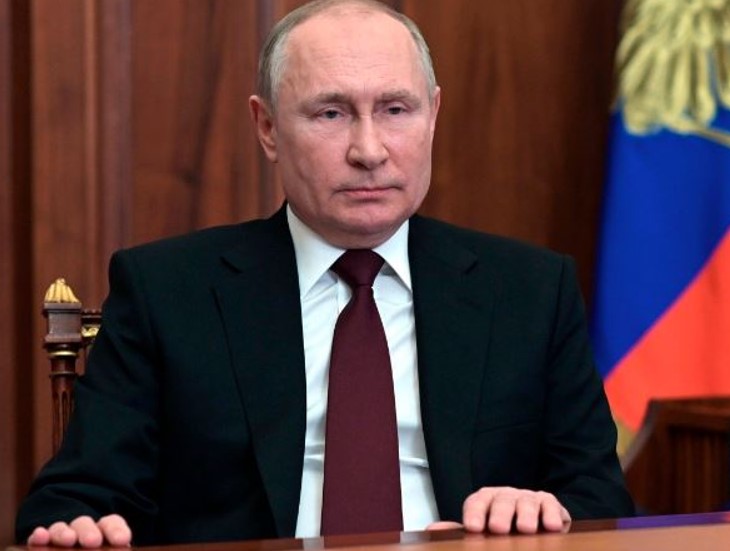
"They will hang me." That's what Vladimir Putin has reportedly told insiders inside the Kremlin when the conversation turns to what happens if the war in Ukraine ends without a Russian victory. Not "I'll lose the election." Not "I'll retire to a dacha." Hanged.
When the dictator's private fear isn't exile but execution, you're not watching a negotiation anymore. You're watching a cornered animal.
The reporting comes from The Economist, which cited Kremlin insiders describing Putin's calculus in starkly personal terms. The Russian president apparently understands something his own propaganda won't say out loud: nearly five years into what he still officially calls a "special military operation," the walls are closing in, and the only thing keeping them from collapsing is forward momentum. His September 2022 mobilization decree remains in effect. Russia is reportedly preparing 400,000 additional soldiers for deployment — without a formal public announcement.
That's worth pausing on. Four hundred thousand troops being quietly assembled while Putin addresses members of the United Russia party on August 22 with the line, "The special military operation continues. We will move only forward."
Meanwhile, Ukraine isn't sitting still. Over a recent four-day stretch, Russia launched nearly 1,500 drones at Ukrainian targets — more than half of them jet-powered. Putin accused Ukraine of opening a "Pandora's box" after Kyiv began striking Russian oil infrastructure, energy facilities, and logistics networks deep inside Russian territory. According to Ukraine's agriculture minister, 90% of the country's food logistics infrastructure has been destroyed by Russian strikes.
So both sides are grinding each other into dust. The difference is that Volodymyr Zelensky's survival depends on Western support continuing. Putin's survival — by his own private admission — depends on never stopping the war.
That distinction matters more than any battlefield map. A leader who believes peace means a noose doesn't negotiate in good faith. He escalates. He mobilizes another 400,000 men without telling the public. He launches 1,500 drones in four days. He calls the enemy's counterattacks a "Pandora's box" while his own cities remain largely untouched by comparison.
The Western foreign policy establishment has spent nearly five years cycling through theories about what Putin "really wants" — Donbas, a land corridor, NATO neutrality, restored imperial borders. The Economist's reporting suggests the answer is simpler and uglier than any of those. He wants to not die.
Every dictator who wages a forever war eventually faces the same math. The war becomes the only thing preventing the consequences of having started the war. The troops, the drones, the 400,000 quiet reinforcements — none of it is about victory. It's about making sure the question of what comes after never gets answered.
When a man with nuclear weapons tells his inner circle he's afraid of the rope, "moving only forward" stops being a slogan and starts being a survival strategy with global consequences.

Comments are closed.