

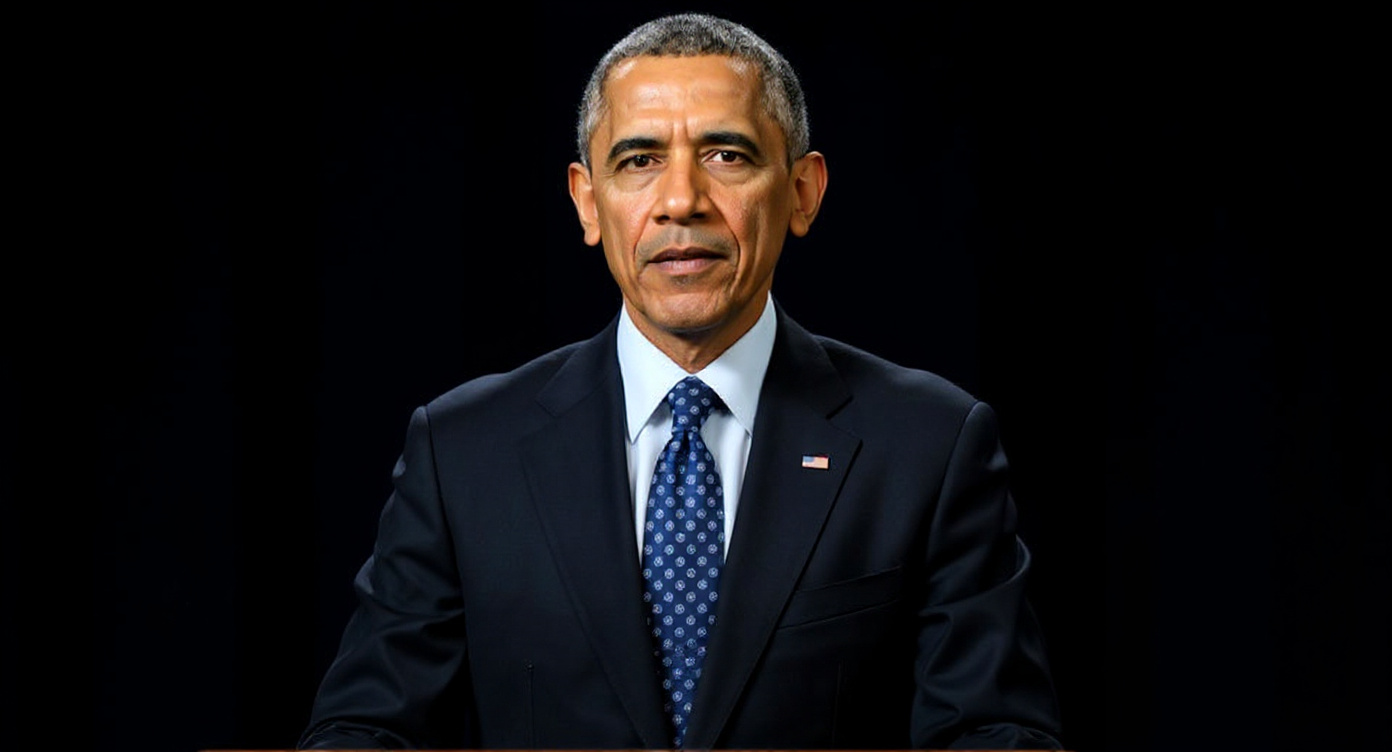
Barack Obama has a message for House Minority Leader Hakeem Jeffries: "Once you are speaker, I would strongly urge that the Democrats put together a framework for a very public conversation." The conversation he's demanding isn't about inflation, or the border, or crime. It's about artificial intelligence. The former president wants Democrats to make government control of AI the centerpiece of their entire 2026 midterm campaign.
The man who couldn't stop running things from behind the curtain just handed Democrats their marching orders — and they snapped to attention on cue.
Jeffries responded the way a subordinate responds to a directive from the boss. "President Obama is correct that decisive action must be taken on artificial intelligence," the House Minority Leader said. "Republicans have abdicated their responsibility." No deliberation, no counteroffer, no "let me think about it." Obama spoke, and Jeffries agreed. The most transparent president in history is once again operating from the least transparent position possible — no office, no accountability, no election to face — just a phone call and a party that does what it's told.
This isn't a new fixation. Obama laid the groundwork back in March 2025, when he told an audience at Hamilton College that "big disruptions" require us "to reorganize our societies." That phrase — reorganize our societies — did exactly zero of the heavy lifting that a specific policy proposal would require. But it sounded important. Then in May, he traveled to Toronto to meet with Canadian Prime Minister Mark Carney, folding AI anxiety into the same globalist framework that produced the Trans-Pacific Partnership and every other trade deal that shipped American jobs overseas while promising "smart governance."
The pattern is familiar. Obama picks a cause that sounds forward-thinking, wraps it in urgency, and builds a regulatory apparatus around it before anyone can define the problem. Senator Jon Ossoff of Georgia is already on board, calling for a president who would "rush inspectors into frontier labs, fortify the nation against bioterrorism." Rush inspectors into labs. That's the Democratic pitch for the midterms: more bureaucrats, moving faster, into places they don't understand.
Here's what makes the timing interesting. A Fox News poll found that 70% of voters oppose AI data centers being built in their communities. Obama sees that number and reads it as an opening — fear he can organize around. What he doesn't mention is who benefits most when America slams the brakes on its own AI development.
China does.
Treasury Secretary Scott Bessent put it plainly: "There is no day after tomorrow if China wins at this. If they were to pull away from us on AI, then nothing else would matter." Even Dario Amodei, CEO of Anthropic — one of the leading AI companies — has warned that Chinese AI projects "will run the alignment risks that U.S. companies are carefully preventing, and even if they avoid those risks, they will be in a position to militarily dominate democracies." The man building the technology is telling you that the real danger isn't American AI moving too fast. It's American AI moving too slow while Beijing doesn't.
Amodei has also called for slowing the pace of AI development in the U.S., arguing "we must slow the pace at which we improve the capabilities of AI models." But his own warning about China undermines that position. You can't argue that China will militarily dominate democracies if it pulls ahead, and simultaneously argue that we should slow down. One of those statements defeats the other.
David Sacks, Trump's former AI czar, identified what's actually driving the push. The goal, Sacks said, is "to further 'Global AI Governance,' a massive power grab by the bureaucratic state and globalist institutions." The United Nations and the World Economic Forum have been circling AI governance for years. Obama's re-emergence gives that effort a domestic face and a political vehicle — the Democratic midterm campaign.
Emil Michael, the top Pentagon official overseeing AI implementation for the U.S. military, offered the clearest rebuttal of the regulatory fantasy Obama is selling. "It's a sort of dystopian, 'Brave New World' view of the world, where machines that are using 1s and 0s are going to have no bias," Michael said. The people actually deploying AI for national defense understand something Obama's framework ignores: the technology is a tool, and the country that wields it best wins. Regulation doesn't make tools safer. It makes them slower. And in a race with China, slower is losing.
Obama built NAFTA-era trade deals that hollowed out manufacturing. He championed the TPP that would have outsourced economic sovereignty to multinational tribunals. Now he wants to "reorganize our societies" around AI policy designed in the same boardrooms and faculty lounges that got the last three decades wrong.
Jeffries said Republicans abdicated their responsibility. The Trump administration put an AI czar in the White House and an AI implementation chief in the Pentagon. Democrats are proposing inspectors.
That 70% opposition number is real. So is China's head start if we let Obama turn fear into a regulatory framework. The last time he reorganized something, we got the TPP.

Comments are closed.