

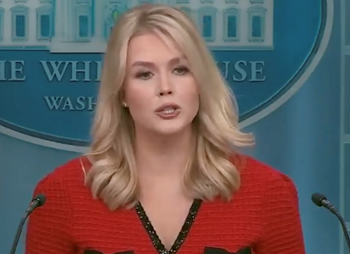
Karoline Leavitt, the youngest White House press secretary in American history, announced she's leaving the podium at the end of August. She's 28 years old, has a two-year-old son named Niko and a three-month-old daughter named Vivi, and says she wants to spend more time with her young family.
The press corps she spent seven months bodying hasn't even finished celebrating, and the jockeying to replace her is already underway.
President Trump called Leavitt "one of the best White House Press Secretaries in the History of the Office" — and for once, the capital letters feel earned. Say what you will about the job, but Leavitt walked into a briefing room full of people who wanted her to fail every single day and made them look small doing it. She returned from parental leave after her second child was born in May and kept the pace without missing a step. Most people in Washington can't return from a long lunch without losing the thread.
Now the question everyone's asking: who's next?
The New York Post reports that the early names drawing serious attention include Alina Habba, the former acting U.S. Attorney for New Jersey who became a household name defending Trump in court, and Matthew Boyle, Breitbart's Washington Bureau Chief. Both would represent a combative pick — someone who views the legacy press not as an institution to be respected but as an opposition force to be managed.
Then there's the conventional route. Harrison Fields, the White House principal deputy press secretary, has been doing the job in practice already. Anna Kelly, another principal deputy, is in the same lane. Steven Cheung, the current White House communications director, has the institutional knowledge and the trust.
But the deeper bench is where it gets interesting. Taylor Budowich, former White House deputy chief of staff, has been in the Trump orbit for years. Katie Miller — yes, Stephen Miller's wife and former press secretary to Vice President Pence — knows the machinery cold. Monica Crowley, currently serving as U.S. chief of protocol, has the media background and the composure. Jason Miller, a longtime Trump adviser, has been floated in every staffing conversation since 2016.
And then there are the outside-the-box names: Rachel Campos-Duffy from Fox News, conservative commentator Scott Jennings, and Kari Lake, the former Arizona gubernatorial candidate who never met a camera she couldn't dominate.
A White House source told reporters that Trump has not yet settled on a replacement. Which means the audition is live.
Here's what matters about this list: every single name on it is someone the legacy media already despises. There is no olive-branch pick. There's no "let's reset the relationship with the press" candidate being floated by anyone who matters. That era ended sometime around 2017, and nobody in this White House is nostalgic for it.
The left-wing media complex is already framing Leavitt's departure as some kind of internal dysfunction signal — the "surprise departure" headline is doing a lot of heavy lifting for people who want to read chaos into everything. A 28-year-old mother of two small children deciding to step back from the most publicly hostile job in government isn't a mystery. It's basic math. The surprise would have been if she'd stayed another three years while her kids grew up watching briefing clips instead of their mother.
What's telling is what the administration didn't do. They didn't announce a successor in the same breath. They didn't package this as a promotion-and-transition story. They let Leavitt have her moment, gave her the praise she earned, and left the next chapter open. That's either genuine respect or very good stagecraft. Probably both.

Comments are closed.