

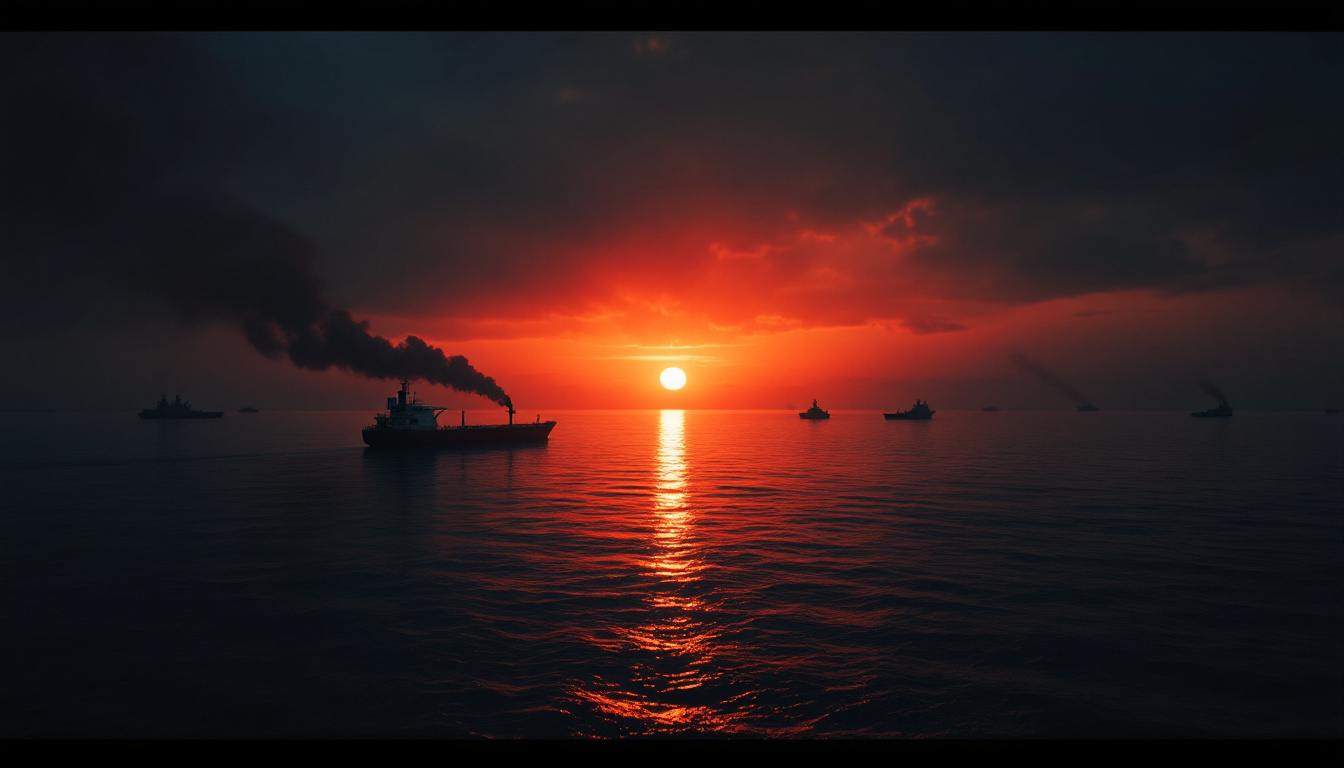
At 7:15 p.m. ET on Friday, U.S. Central Command forces began launching the third round of strikes this week against Iran. The target list ran over 300 sites deep — missile launchers, drone bases, naval assets, ammunition depots, communication networks, and coastal surveillance stations.
The reason was not complicated. Iran shot at a cargo ship.
The Islamic Revolutionary Guard Corps Navy fired on the M/V GFS Galaxy, a Cyprus-flagged container ship transiting the Strait of Hormuz — the narrow waterway through which roughly 20% of the world's oil supply passes every single day. The attack caused heavy damage to the vessel's engine room. One crew member is still missing.
Then, because apparently disabling a commercial freighter wasn't enough theater for one evening, Iran's IRGC declared the Strait of Hormuz "closed until further notice." Just like that. A military branch of a country whose entire GDP ranks below that of New Jersey decided the most important shipping lane on the planet was now off-limits to global commerce.
The response from CENTCOM was not a press conference. It was not a sternly worded letter to the United Nations. According to the command's own statement, forces struck "Iranian missile and drone sites, naval capabilities, ammunition storage facilities, communication networks, and coastal surveillance locations" — more than 300 targets across three nights of operations this week, all at the direction of the Commander in Chief.
The U.S. had previously demanded a public Iranian statement confirming the Strait would remain open to international shipping. Iran's answer was to attack the GFS Galaxy instead.
Tehran then escalated further, launching missiles and drones at U.S. bases in the region after the American strikes began. We are now watching a full-scale military exchange between the United States and Iran over freedom of navigation — a concept that used to be so uncontroversial that even the Obama administration at least pretended to care about it.
President Trump had previously warned that "1,000 missiles" were aimed at Iran in the event it moved against American interests. The IRGC apparently decided to test whether that was a bluff.
It was not a bluff.
Contrast this with four years of the previous administration's approach to Iranian aggression. The Houthis — Iran's proxies — spent months attacking commercial shipping in the Red Sea while Washington issued statements expressing "deep concern" and occasionally lobbed a few retaliatory strikes that changed nothing. Iran's drone program expanded. Its proxies grew bolder. Its navy harassed vessels in the Gulf with near-total impunity.
The calculation in Tehran was apparently that America would continue to treat the Strait of Hormuz the way it treated the Red Sea — as someone else's problem. The IRGC fired on a civilian ship, declared a major international waterway closed, and waited to see what happened next.
What happened next was 300 targets.
There is a straightforward lesson in this sequence of events, and it has nothing to do with ideology. When a nation fires on civilian commercial vessels in international waters and then claims sovereignty over a shipping lane that belongs to everyone, there are exactly two possible responses. You either enforce freedom of navigation or you concede it. One option costs missiles. The other costs the global economy.
The Strait of Hormuz is open today because someone chose the missiles.

Comments are closed.