

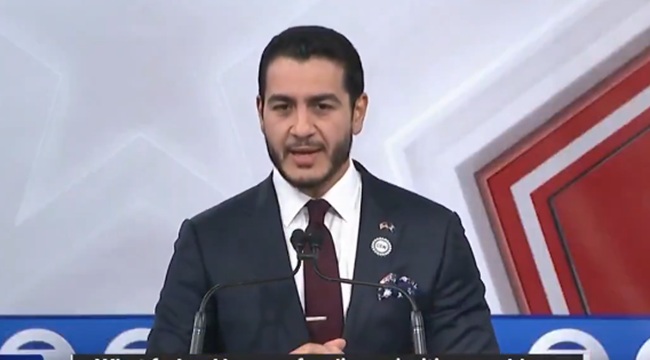
Ross Douthat asked Abdul El-Sayed a simple question on CBS News' 60 Minutes: Does Israel have a right to exist?
El-Sayed's answer started with a different question entirely.
"I don't ever get the question of, 'Does Palestine have the right to exist?'" the Democratic candidate for Michigan's Senate seat responded. Douthat pressed. El-Sayed attempted what appeared to be the word "yes" — then immediately veered. "S— yes. If there is a shared understanding—" He stopped. Started again. "Let me just— let me just— let me just— understand."
Three false starts on a yes-or-no question.
What followed was the full diplomatic contortion: "I believe in equal rights to peace, dignity, and self-determination for Palestinians and Jewish Israelis alike. If the Palestinian people decide and the Israeli people decide that they want two states for two people, and they decide that on equal terms, I'm for it. If they decide that they want one state shared in a different way, I'm for that."
Read that again slowly. El-Sayed said he supports whatever "the Palestinian people and the Israeli people decide" — including a single shared state. That's not a throwaway line. A one-state framework that dissolves Israel's identity as a Jewish state is the position of organizations that explicitly reject Israel's right to exist. El-Sayed wrapped it in the language of self-determination. The structure of the answer is the answer.
Douthat, to his credit, didn't let it slide. He caught the redirect — El-Sayed had answered a question about Palestine's right to exist that nobody had asked, while dodging the one that was actually on the table. The interviewer pushed back: "Wait. You said— you said—"
El-Sayed is running against Republican Mike Rogers for the Michigan Senate seat in a 2026 midterm cycle where every Senate race matters. Michigan has one of the largest Arab American populations in the country. A straight "yes, Israel has a right to exist" costs him part of his base. A straight "no" ends his campaign everywhere else. So he chose door number three: say enough words that the transcript looks like an answer while the clip tells a different story.
The problem with door number three is that it's 2026 and everyone has the clip. The stammering. The redirect. The three attempts to start a sentence before landing on a paragraph-long non-answer. Voters aren't reading the transcript. They're watching a man who wants to represent Michigan in the United States Senate physically unable to affirm that America's closest ally in the Middle East should continue to exist.
El-Sayed offered a framework where both sides get to decide the outcome together, on "equal terms." He didn't define what equal terms means. He didn't have to. The 60 Minutes audience saw a candidate who couldn't say one word.
The word was "yes." He had it. He started it. He couldn't finish it.

Comments are closed.