

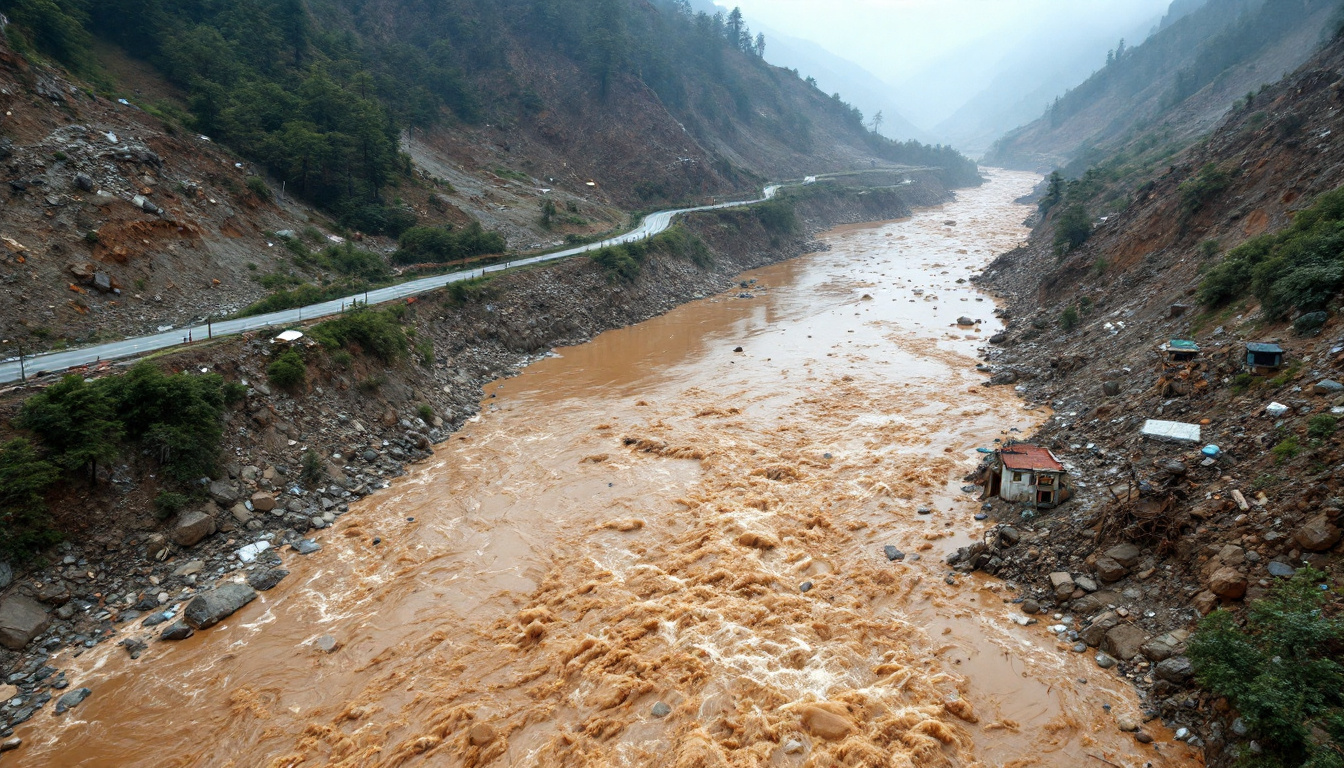
A 4.4 magnitude earthquake hit the Himalayan border between Nepal and China-controlled Tibet. Seven minutes later, 8-to-10-meter-high waves of mud, rock, and river water swallowed entire villages downstream.
157 people are already confirmed dead. Nearly 500 Nepalese citizens and tourists are still missing. 47 of them are American citizens.
Nepal's Foreign Minister Shisir Khanal told parliament that "the floods could be the result of an avalanche triggered by an earthquake" — a cascade event where the initial quake sent a wall of rock and debris crashing into a river system that runs along the Nepal-China border. The collapse created a natural dam that burst with catastrophic force, sending floodwaters ripping through Trishuli Bazar and the surrounding Rashuwa district.
The videos look less like a flood and more like a biblical reckoning — walls of water carrying boulders the size of cars through narrow mountain valleys.
The epicenter of the destruction traces back to the area near Jilong Port in Tibet, where the initial landmass collapsed into the river. The German Research Centre for Geosciences, known as GFZ, confirmed the 4.4 magnitude earthquake that preceded the disaster. What followed was seven minutes of seismic silence before the water arrived. Seven minutes between an earthquake most people wouldn't even feel and a flood that killed nearly a hundred.
Qianggong Zhang, a researcher at the Kathmandu-based International Centre for Integrated Mountain Development, warned that a blockage remains lodged upstream on the Nepal-China border river. His assessment is blunt: a second flood may occur. The natural dam hasn't fully cleared, which means the same river system that just killed 95 people is still holding back water and debris that could release at any moment.
Another angle of the wall of water
The 47 missing Americans haven't been identified publicly. What we know is that nearly 500 tourists, mainly from China, were in the affected region when the floods hit, and search-and-rescue operations are fighting terrain that was barely accessible before a mountain fell into a river. Nepal's infrastructure in these areas was never built for this kind of event — narrow roads carved into cliffs, bridges that span gorges, villages perched on riverbanks that existed for centuries because the water had never risen that high.
The China-controlled Tibet side of the border presents its own problem. Information flow from that region has never been what you'd call transparent, and coordinating cross-border rescue efforts with Beijing adds a layer of bureaucratic friction that missing tourists can't afford. The mudslide originated on terrain that straddles two very different governments with very different ideas about urgency and accountability.
Another angle of what happened
This is the kind of disaster that exposes how fragile the modern assumption of safety really is. Tourists book trips to the Himalayas because the views are on Instagram. Nobody checks whether the mountain above their hotel is structurally sound or whether the river beside the road has a natural dam upstream that a minor earthquake could dislodge.

Comments are closed.